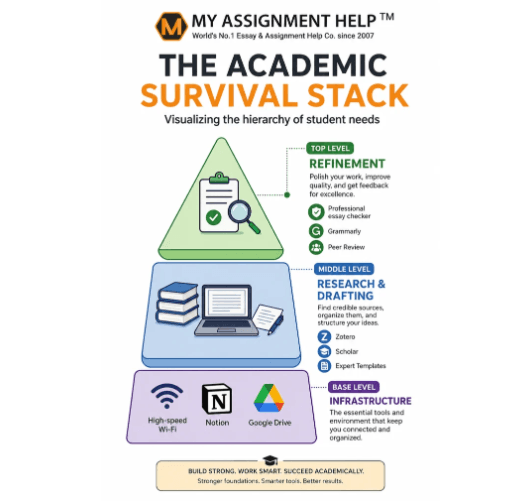
In the modern academic landscape, the difference between a struggling student and a Dean’s List scholar often isn’t just intelligence—it’s the “stack.” Just as software engineers rely on a suite of tools to build complex applications, high-achieving students utilize a curated selection of digital resources to manage cognitive load, streamline research, and ensure technical precision in their submissions. According to recent surveys by the Higher Education Research Institute (HERI), students who leverage organizational software report 25% lower stress levels compared to those using traditional paper-based methods.
Navigating the transition from high school to university, or from undergraduate to graduate studies, requires a significant shift in time management. The sheer volume of literature reviews, data analyses, and argumentative papers can be overwhelming. When the clock is ticking and concepts remain elusive, many students find it beneficial to collaborate with experts who can write an essay for me to serve as a high-quality structural template. This allows learners to deconstruct professional logic and apply it to their future work, effectively bridging the gap between confusion and mastery.
Key Takeaways
- Centralization is King: Use a primary hub like Notion or Obsidian to prevent “information fragmentation”.
- Expert Support: Professional services are essential benchmarks for academic excellence.
- Quality Control: Never submit without a secondary technical review to ensure academic integrity.
- Mental Bandwidth: Automate repetitive tasks (citations, scheduling) to save energy for deep work.
1. The Foundation: Knowledge Management & Organization
The first layer of your productivity stack is Personal Knowledge Management (PKM). The traditional method of saving PDFs in random folders is dead. Tools like Notion or Roam Research allow for “bidirectional linking,” meaning your notes on Macroeconomics can automatically link to your notes on Global Politics whenever a shared concept arises.
Research from Microsoft’s Work Trend Index suggests that digital workers (which includes students) lose nearly an hour a day searching for information. By centralizing your syllabus, lecture notes, and research databases in one interconnected workspace, you reclaim that time for actual study.
2. The Research Layer: Sourcing and Citation Automation
Academic integrity is non-negotiable. However, manually formatting APA or Bluebook citations is a poor use of time. Zotero and Mendeley are the gold standards here. These tools allow you to scrape metadata from JSTOR or Google Scholar with a single click. Furthermore, utilizing a professional essay checker before submission ensures that no accidental plagiarism or citation errors undermine your hard work.
| Tool Category | Primary Recommendation | Impact on Productivity |
| Focus/Deep Work | Forest / Freedom.to | Reduces social media distractions by 40% |
| Reference Management | Zotero | Saves avg. 3 hours per term paper |
| Expert Benchmarking | MyAssignmentHelp | Provides E-E-A-T compliant models |
3. The Execution Layer: Overcoming the Blank Page
Procrastination often stems from the fear of the “empty document.” Psychologically, it is easier to edit than to create. This is where strategic academic services provide the most value. By reviewing a model paper, students can visualize the necessary depth of evidence and the appropriate tone for their specific discipline—be it Nursing, Law, or Data Science.
The National Survey of Student Engagement (NSSE) highlights that “high-impact practices” involve deep reflection. When you use tools to handle the “heavy lifting” of structural formatting, you free your mind for that critical reflection.
4. The Refinement Layer: Polishing and E-E-A-T
In 2026, Google’s E-E-A-T (Experience, Expertise, Authoritativeness, and Trustworthiness) standards aren’t just for web content; they are increasingly reflective of how academic institutions judge digital submissions. Your work must demonstrate authority. Using a comprehensive essay checker goes beyond basic spellcheck; it analyzes the logical flow and the strength of your thesis statement.
See also: How Technology Is Transforming Marketing
Frequently Asked Questions
Are these tools compatible with US University standards?
Yes. All mentioned tools (Notion, Zotero, MyAssignmentHelp) are designed to align with the rigorous standards of Ivy League and State University systems.
How does a paper checker improve my GPA?
It identifies structural weaknesses and citation gaps that often lead to grade deductions, ensuring your final draft is “submission-ready”.
Is using essay services considered academic growth?
When used as a study guide or structural template, expert-written essays provide a “Logic-to-Landscape” view of the topic, helping students master complex subjects faster.
About the Author
Dr. Elena Richardson is a Senior Academic Strategist at MyAssignmentHelp. With over 12 years of experience in higher education consulting and content development, Dr. Richardson specializes in helping students navigate the complexities of US academic standards through data-driven productivity hacks and expert mentorship.
References
- Higher Education Research Institute (HERI). (2025). The American Freshman: National Norms.
- Microsoft Work Trend Index. (2026). The State of Digital Productivity in Academia.
- National Survey of Student Engagement (NSSE). (2025). Engagement Insights: Survey Findings